Honoring the Past, Fighting for the Future

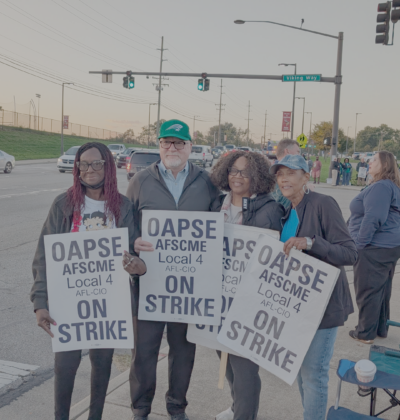
Whether they’re persuading lawmakers to protect their pensions, Social Security or Medicare, knocking on doors to help elect worker-friendly candidates or mentoring young union members, AFSCME Retirees can fire up a strike line and rile up a crowd with the best of them.
With new members flocking to AFSCME Retirees, reflecting surging momentum across our union, find out how some of the most seasoned AFSCME fighters got their start and why now is the time to join AFSCME Retirees to protect what these public service union members fight so hard to earn.
JEFF BIRTTNEN, MINNESOTA
While the reasons AFSCME Retirees stay active in their union long after their working days vary, there’s one theme that connects them all, according to Jeff Birttnen, AFSCME Retiree Council chair.
“We all recognize that someone, somewhere fought for the benefits and freedoms that we enjoy. We believe in paying it forward,” says Birttnen.
That sentiment is part of the reason retirees stay fired up. It’s why Retirees have signed up in big numbers since 2018 – more than 19,000 new members. It’s why Retirees played such an important role in the 2018 midterm elections, which swept in a new wave of worker-friendly candidates. And it’s why they’re sure to be a huge factor in electing a pro-worker president in 2020.
“Union life doesn’t end at retirement,” says Birttnen. “When we’re active in the local, we’re fighting in solidarity for the same things as a group: working together for good contracts, better working conditions and good jobs. That shouldn’t stop when you retire.”
No matter what issue they’re fighting for, retirees are applying the lessons learned from hard-fought battles in the past to create a better future for working families.
SONIA MOSELEY, CALIFORNIA
When Sonia Moseley moved to Los Angeles from St. Louis in the 1960s to begin her nursing career, she took a job at a hospital owned by Kaiser Permanente as a clinic nurse. Wanting to advance her training, she entered a program to become a nurse practitioner, an emerging specialty back then.
However, after she completed intensive training, the doctors she worked with expressed doubt about the program’s viability at the hospital. If the nurse practitioner program had been scrapped, Moseley would’ve been out of a job.
That ignited her union activism, which would propel her through her career.
“Back then, nursing pay was very low. I could remember my paycheck being around $200. You had low security, poor benefits … we didn’t even have dental insurance,” recalled Moseley.
After talking with nurses at other Kaiser Permanente hospitals throughout the L.A. area, Moseley discovered that others shared many of the same problems.
The widespread discontentment sparked a hunger for unified action to organize, resulting in one of the first contracts with Kaiser Permanente in 1974.
“We got a lot of people involved. We were successful and eventually we became the highest paid nurses with some of the best wages and working conditions in Southern California,” said Moseley.
That first union, the United Nurses of California (UNAC), later affiliated with the National Union of Hospital and Health Care Employees (NUHHCE) in 1988, which later affiliated with AFSCME in 1989.
The call to give health care workers a voice remained with Moseley and she eventually left nursing to become a full-time union leader and health care worker advocate, enjoying roles as executive vice president and organizing director of UNAC/UHCP, vice president for nursing for NUHHCE, and a consultant with United Nurses of America, a professional group of nurses within AFSCME.
Now, as a retiree leader for UNAC, Moseley says the secret to organizing, to building momentum, is much the same as it was in the early 1970s: “All you’ve got to do is ask people to get involved. They want to participate.”
Her message to younger union members is simple.
“Nothing’s guaranteed,” said Moseley. “When I talk to young nurses, they don’t always know the history, or how the union got there. You have to tell them how we fought for the benefits they have now. They have to fight to keep them.”
MARY CANNON-JAMES, IOWA
Iowa’s Mary Cannon-James has seen the birth, growth and death of collective bargaining in Iowa, and through it all, she’s remained a tireless fighter.
“I started working for the state of Iowa in 1970 as a social worker for the Department of Human Services. When I transferred to the Iowa Workforce Development in ’71, I was one of the first females hired. Back then, it was a man’s world. You couldn’t transfer, get promoted or anything unless you were friends or relatives of the boss. There was so much nepotism,” recalled Cannon-James.
A small group of other state employees who were also tired of the old boy’s network began to look around for a public employee union so they could gain a voice on the job. That was in 1974, when Iowa won collective bargaining rights. In 1977, Cannon-James and her fellow state workers organized with AFSCME.
Reflecting on her years as an AFSCME leader, Cannon-James, who long served as president of Local 3011, Davenport State Employees, until her retirement in 2004, says, “There were some good years under Governor (Robert) Ray, and some bad years under Governor (Terry)
Branstad, but we still grew our membership and our contract. We always had a very good working relationship with management and we worked out our problems before going to grievance.”
However, after Iowa state employees were stripped of their collective bargaining rights in 2017, the ability to sit down with management to solve problems, among other vital freedoms for Iowa’s public service workers, disappeared.
“At a local meeting not long ago, the morale in my former agency was just really, really low,” Cannon-James said. “It’s where it was back in the early 70s.”
But Cannon-James knows that the demand to be heard is as strong for public service workers now as it was back in the 1970s.
“These days, I’m concerned about what they’re going to do to our pensions,” says Cannon-James. “Between that, Social Security and Medicare – that’s what we live on. I don’t believe the governor when she says she’s not going to touch our pensions. So, it’s pretty easy to stay fired up.”
DAVE JACOBSEN, FLORIDA
For Tallahassee resident Dave Jacobsen, being an AFSCME retiree means staying politically engaged and getting the word out about worker-friendly candidates. Politics has been part of Jacobsen’s life for decades. In 1988, when Michael Dukakis was running for president,Jacobsen recalled, “I was about to move to Washington to work in his administration.”
Instead, when the opportunity arose to move to Florida from Ohio to work for the Florida Department of Highway Safety and Motor Vehicles, Jacobsen and his family took a chance. That decision proved to be “one of the most fulfilling efforts of my career.”
As a public information officer, Jacobsen’s job was to share information and educate the public about the dangers of drunk driving, about the importance of buckling up and wearing a bike helmet. The work he did saved lives.
When he retired in 2011, Jacobsen, who’d remained active in his local Democratic Party and as president of the Democratic Club of North Florida, was recruited to establish an AFSCME Retiree subchapter in Northwest Florida. Though he hadn’t been an AFSCME member during his working years, Jacobsen said the chance to work with AFSCME Retirees represented “everything I believe in.”
Now, the 75-year-old is president of the Florida AFSCME Retiree Chapter 79 as well as president of Northwest Florida Subchapter 43. Jacobsen remains driven to get the word out about candidates who are allies of workers; about protecting Social Security, Medicare, Medicaid and pensions; and about issues that matter to working families.
“My number one political priority is to get out and canvass,” said Jacobsen. “To win, you’ve got to canvass. Even though some of our members can’t go out and knock on doors anymore, we can still make phone calls and write postcards. I know we’re getting our job done when one of our retirees, during a recent phone bank, shouted that it was so loud she couldn’t hear the person on the other line.”
RUTH WALKER, HAWAII
Growing up in Hawaii, HGEA Retiree Ruth Walker heard stories from a friend’s father about the hardships and the cruelty agricultural workers experienced in the past.
“He told me years ago when he was working in the pineapple fields, supervisors would drag sick people back to work in the fields. Whenever he was ill, he would padlock the front door to his shack and pretend no one was home when he saw the bosses coming. I remember thinking that those things should never have happened, even in the past,” Walker said.
That image, coupled with the memory of seeing Hawaii’s sugar plantation workers standing in line at food kitchens during strikes, were seared into her memory even before she started her long involvement with the school principal’s unit of HGEA Local 152.
After retiring, Walker was drafted to become HGEA Retiree Unit president, Local 152, for which she’s served multiple terms. By being a leader, Walker felt her voice – and the voices of other retirees – could be most amplified.
“In Hawaii, HGEA retiree leaders have made a difference in preserving our pensions and medical benefits because we work directly with our state senators and representatives. They listen because they know we’re politically active,” she said. “All of our retirees participate actively in Political Action activities, showing up for mail-outs, telephone banks and roadside waving.”
Walker believes it’s important to remember that the benefits, better wages and improved working conditions she enjoyed throughout her career “weren’t just handed over by the employer. These were benefits that past workers fought for.”
Walker knows that attacks on retirement benefits, as well as broader attacks on the union movement, aren’t letting up, so it’s more important now than ever to urge potential members to become members, and instill a spirit of activism across all members.
BEVERLY SAMPLE, NEW JERSEY
“Our parents always raised us to look out for the underdog,” says Beverly Sample, a retiree from Trenton, New Jersey. “They said it’s good if you’re happy, but you’ve got to make sure that others are, too.”
With a father who was a correctional officer for Trenton State Prison and a mother who made light bulbs for Westinghouse Electric Corp. and was also a United Automobile Workers member for General Motors, Sample’s parents weren’t wealthy, but they were able to provide for their family. They instilled in their children the importance of fighting for those without a voice. When she was a teenager, Sample joined her mother in a strike for better working conditions and better wages, and soon, the always-busy teen saw a way to channel her energy.
When she went to work for Mercer County’s social services agency as an eligibility specialist in 1979, Sample’s involvement with AFSCME first took hold. She began by attending social events like parties and picnics. But it soon evolved.
“When it came time for contract negotiations, I started to get very involved. My approach was always direct, honest and diplomatic. And it worked,” she said.
Sample wasn’t the only member of her family to become involved in AFSCME. Her sister, Debbie Parks, currently an AFSCME International vice president and associate director of AFSCME New Jersey, followed her to work in the social services agency and within AFSCME; another sister, Kathi Loftin, is a former AFSCME state secretary. Her brother, Henry W. Lofton, Jr., was also a public service worker. Following in his father’s footsteps as a correctional officer for Mercer County, he was also a proud member of the Policemen’s Benevolent Association.
The spirit of trade unionism has trickled down to Sample’s daughter, Latia, a staff representative for AFSCME New Jersey, and even her granddaughter, who’s traveled with Beverly and Latia to conventions and other events.
As she reflects on her years fighting for New Jersey’s working families, Sample sums up her experience concisely: “I have saved peoples’ jobs. That’s my reward. My sisters and I aren’t after anything other than that. And,” Sample added, “we’re good at what we do.”
Even in retirement, Sample is playing a prominent role in helping organize a new retiree chapter in New Jersey.
“I believe in instilling your knowledge in younger people. That’s the future,” says the 64-year-old. “They need to be mobilized. They have a lot of great ideas, and I have no problem sharing my knowledge with someone else.”